If You Don't Subtract Repeat Customers, Your Paid Ads Are Lying to You
The blended metric trap
Your ad dashboard says your campaigns are crushing it. A 4x return on ad spend. A cost per acquisition that finance is happy with. Conversions climbing month over month. So why does growth feel stuck?
Here's the uncomfortable answer: a large chunk of the "wins" your paid ads are taking credit for were never new wins at all. They're your existing customers, people who already know you, already love you, and would have bought from you anyway. When those repeat buyers get folded into your acquisition numbers, every metric you rely on quietly inflates. Your ads look like acquisition machines when they're actually just expensive coupons handed to loyal fans.
If you've never separated new customers from returning ones in your reporting, this post is going to change how you read every number on your screen.
Most advertising platforms Meta, Google, TikTok report on a blended basis by default. A conversion is a conversion. The platform doesn't know, and frankly doesn't care, whether the person who clicked your ad was a stranger discovering you for the first time or a regular who buys every month and just happened to tap an ad on the way to checkout.
That distinction is everything.
Paid advertising has one core job in a growth engine: bring in people who weren't already coming. Retention, loyalty, and lifecycle marketing handle the people you've already won. When repeat customers show up inside your paid acquisition metrics, two channels are claiming credit for the same revenue and the louder, more measurable one (paid ads) usually wins the argument inside your company.
The result is a feedback loop that quietly burns money. You see strong ROAS, so you scale spend. Scaling spend reaches more of your existing audience through retargeting and broad targeting. Those existing customers convert at high rates because they already trust you. ROAS stays strong, so you scale again. Round and round, while true new-customer growth the only thing that actually expands your business barely moves.
A simple example that exposes the lie
Let's make this concrete with round numbers.
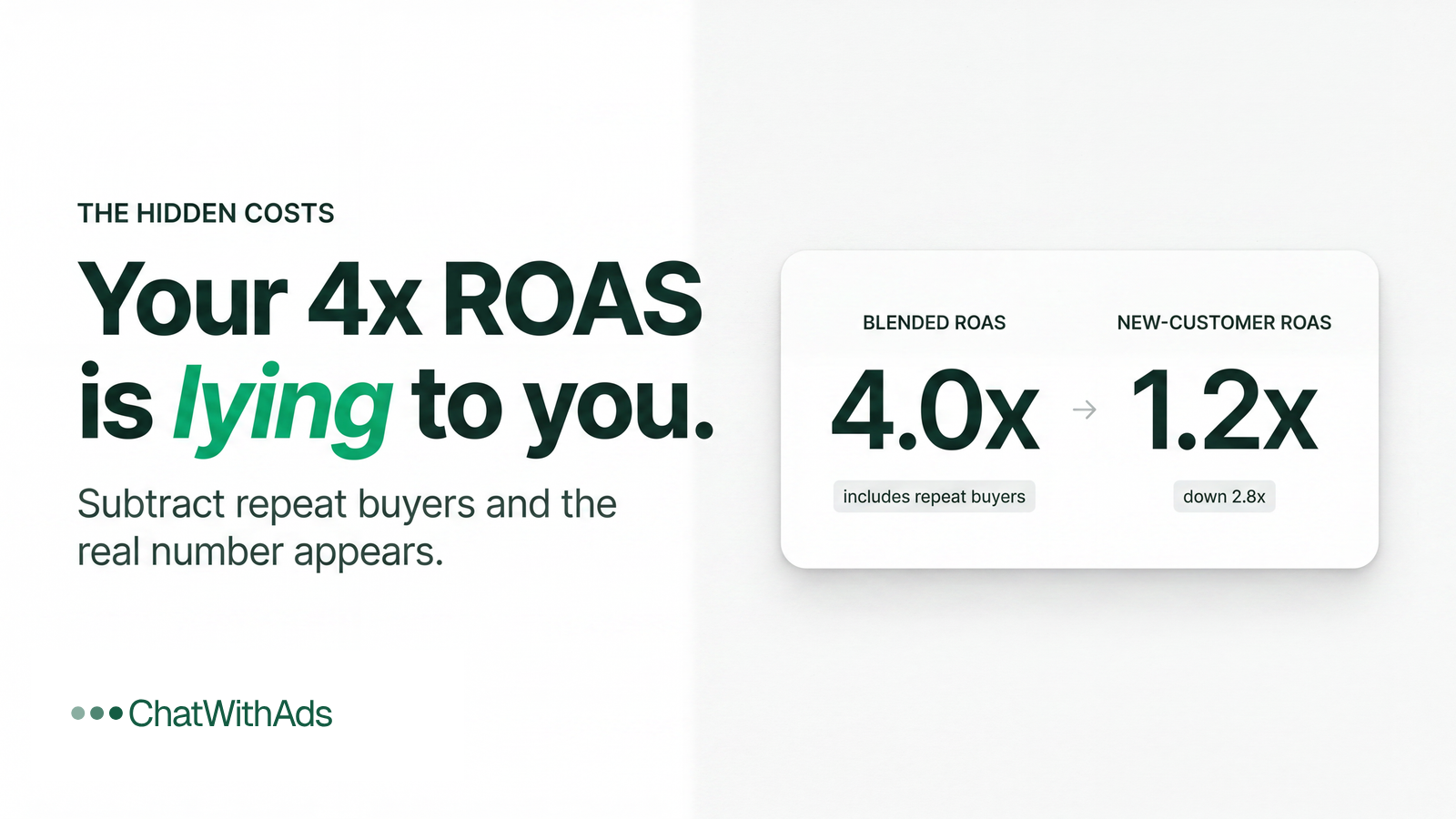
Say you spend $10,000 on ads in a month and the platform reports $40,000 in attributed revenue. That's a 4x ROAS. Beautiful.
Now you dig in and discover that of those purchases:
- $28,000 came from existing customers who'd bought from you before
- $12,000 came from genuinely new customers
Suddenly the picture flips. Your new-customer ROAS is 1.2x you spent $10,000 to acquire $12,000 in first-time revenue. If your gross margin is 50%, you actually lost money acquiring those customers in the immediate term. The "4x ROAS" was a comforting fiction built on retargeting people who were already loyal.
This matters because the entire economics of paid acquisition depend on what new customers are worth over time, not what your loyal base spends this week. You can only make smart decisions about scaling, bidding, and budget if you know what you're actually paying to bring in someone new.
The error compounds quietly
The danger isn't a single misleading month it's what the blended number does to a year of decisions. Because the inflated ROAS tells you to keep scaling, you pour more budget into campaigns that are increasingly aimed at people you already own. Over twelve months, you can easily double your ad spend while your actual new-customer count barely moves. On a slide, the account looks like a rocket. In the bank, your acquisition cost has silently crept past what a new customer is even worth.
Worse, it distorts your strategy. Creative tests get judged on blended ROAS, so the ads that "win" are often the ones that resonate with existing fans, not the ones that hook strangers. Budget shifts toward the channels and audiences that look efficient which are usually the ones closest to your existing base. Step by step, your entire growth engine gets tuned to talk to people who already arrived, and the door to genuinely new demand slowly closes.
Why this happens to almost everyone
This isn't a sign of incompetence. It's the default state of digital advertising, and several forces push you toward it:
Retargeting is seductive. Retargeting campaigns almost always show gorgeous ROAS, because you're advertising to people who already wanted to buy. They're cheap to convert, so the numbers look incredible but you're mostly paying to influence purchases that were going to happen regardless.
Attribution windows are generous. A 7-day click or 1-day view window will happily credit an ad for a repeat customer who was going to reorder anyway and clicked an ad in passing.
Reporting defaults hide it. Out of the box, no platform splits new versus returning revenue for you. You have to deliberately build that view, and most teams never do.
It feels good. Big ROAS numbers make for great slides. There's an emotional incentive not to look too closely.
The metrics that actually tell the truth
To stop your ads from lying to you, shift your attention to a small set of numbers that isolate genuine acquisition:
New-customer ROAS (or nCAC). This is your revenue divided only by spend from first-time buyers. It's almost always lower than blended ROAS and that's the point. It's the real cost of growth.
New-customer cost. How much you pay to acquire one genuinely new customer. Track it as a hard line, separate from total cost per purchase.
The new-to-returning ratio in paid. What percentage of your paid conversions are actually new? If 70% of your "acquisition" spend is converting existing customers, you don't have an acquisition channel you have a retention subsidy.
Payback period and LTV against new-customer cost. Once you know your true cost to acquire someone new, you can compare it to what that customer is worth over their lifetime and decide whether the math works.
When you switch your scaling decisions over to these numbers instead of blended ROAS, you stop optimizing toward an illusion.
How to actually separate the two
Fixing this is less about fancy tooling and more about discipline. A few practical moves:
- Tag customers at the data level. Make sure your analytics and platform conversions can distinguish first-time purchasers from repeat ones. Most ecommerce platforms expose a "new vs returning customer" dimension use it.
- Use platform-level new-customer optimization. Meta and Google both offer settings that bias delivery toward new customers or let you report on new-customer acquisition specifically. Turn them on.
- Build a clean new-customer revenue view. In your reporting, create a dedicated column or report that shows revenue from first-time buyers only, alongside spend, so nCAC is visible at a glance.
- Add a post-purchase "how did you hear about us" survey. Self-reported attribution is a powerful sanity check against platform-claimed credit, especially for catching repeat buyers who were coming anyway.
- Separate prospecting from retargeting budgets. Judge prospecting on new-customer cost. Judge retargeting on incremental lift, not raw ROAS.
The hard part isn't knowing what to do it's doing it consistently, every week, without drowning in spreadsheets and pivot tables. That's where most teams quietly give up and slide back to the comforting blended number.
Make your data answer the question for you
This is exactly the kind of analysis ChatWithAds was built to make painless. Instead of exporting CSVs and wrestling with formulas every Monday, you connect your ad accounts and simply ask: "What's my new-customer ROAS this month versus blended?" or "How much of my paid revenue came from returning customers?" or "Which campaigns are actually bringing in first-time buyers?"
ChatWithAds reads your campaign data and answers in plain language, so the new-versus-returning split stops being a quarterly deep-dive and becomes a question you can ask in ten seconds. You can drill into which campaigns are genuine acquisition engines and which are just retargeting your loyal base, spot the difference between blended and true new-customer cost, and catch the moment a "winning" campaign is really just harvesting existing demand.
The point isn't to add another dashboard to your stack it's to make the honest number as easy to see as the flattering one. When the truth is one question away, you stop scaling fiction.
The bottom line
Paid ads aren't lying to you on purpose. They're answering the question you asked "how much revenue is attributed to this spend?" without telling you the part you actually need to know: how much of that revenue is new.
Subtract your repeat customers, and the fog clears. You'll see which campaigns genuinely grow your business and which ones just take credit for loyalty you already earned. You'll make scaling decisions on real acquisition economics instead of a comfortable blend. And you'll stop confusing a busy ad account with a growing one.
Your loyal customers are wonderful. They just shouldn't be wearing a name tag that says "acquired today." Once you stop letting them, you'll finally know what your ads are really worth and you can spend the next dollar with your eyes open.
Get the next one in your inbox
Marketing-analytics deep dives like this one, straight to your inbox. No spam, unsubscribe anytime.