Tuesday, April 21, 2026
Your Accounts Look Fine. They’re Not. Here’s What Your Ads Are Hiding From You
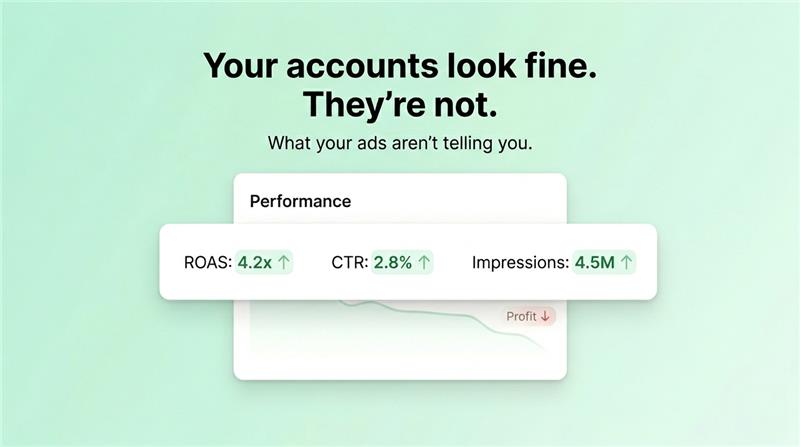
Your dashboard looks clean. CTR is steady. Impressions are climbing. No policy issues. Nothing broken. And yet… sales are slipping. Not crashing, just quietly dropping week after week. You refresh the numbers again, hoping something obvious jumps out. It doesn’t. Everything looks fine.
So why does it feel like something’s off?
Here’s the question most people avoid asking: if your ads are working, why is your bank balance telling a different story?
What is this post actually going to reveal to you?
This isn’t another “optimize your creatives” article. You’re going to see the hidden signals most ad accounts give off long before things collapse, the ones that sit quietly behind good-looking metrics. By the end, you’ll know where to look, what to question, and how to stop trusting surface-level performance.
Why does a “good” ROAS number still leave you losing money?
Let’s talk about ROAS in marketing because most people think they understand it, but very few actually use it correctly.
ROAS simply measures how much revenue you generate for every dollar spent on ads. If you spend $1,000 and generate $4,000, your ROAS is 4x. Sounds solid, right?
Here’s where it gets messy. That $4,000 isn’t profit. It’s revenue. If your cost of goods is $2,000, your margins shrink fast. Add shipping, team costs, software, refunds, suddenly that “great” ROAS doesn’t look so great anymore.
You’ve probably seen this before. A campaign looks strong on paper, but your actual cash position isn’t improving. That’s not a coincidence, it’s a blind spot.
ROAS doesn’t account for your business reality. It doesn’t care about margins, overhead, or scaling inefficiencies. It’s a performance metric, not a profitability metric.
So ask yourself this: if your ROAS is high but your profits aren’t growing, what exactly are you celebrating?
Which platform hides problems better than it shows them?
The debate around Google Ads vs Facebook Ads usually focuses on intent versus discovery. But that’s not where the real risk sits.
Google Ads often feel safer. People are searching. There’s intent. Conversions look clean. But that’s exactly why problems hide there longer. You assume demand equals performance, so you stop questioning efficiency.
Facebook, on the other hand, is noisier. Results fluctuate. Performance swings. Issues show up faster. It forces you to stay alert.
Now imagine this. A brand spends months scaling Google Ads because conversions look consistent. Meanwhile, cost per acquisition slowly creeps up. Margins shrink. But because conversions keep coming, nobody panics.
By the time they notice, profitability is already damaged.
Facebook would’ve exposed that earlier. Google let it slide.
Which platform is actually riskier, the one that shows problems quickly, or the one that hides them behind stable-looking numbers?
Are you trusting a system that’s quietly misleading you?
At some point, you’ve probably used a ROAS estimation tool to validate your campaigns. Plug in ad spend, plug in revenue, get a clean number back. It feels precise. It feels controlled.
But here’s the catch, the output is only as honest as the inputs.
If your attribution window is off, your revenue numbers are inflated. If you’re not including all costs, your spend is understated. If your tracking misses refunds or cancellations, your revenue is overstated.
And suddenly, that neat little ROAS figure is telling you a story that isn’t real.
You’re not alone here. Most marketers don’t intentionally miscalculate, they just trust the data they’re given. Platforms report numbers differently. Tools interpret them differently. Somewhere in between, accuracy gets lost.
You end up making decisions based on “clean” data that’s actually distorted.
So here’s something worth thinking about: when was the last time you questioned the numbers you were plugging in, not just the result you were getting out?
Are your Facebook results real or just being claimed?
The Facebook Ads ROI estimator can make your campaigns look stronger than they actually are, and that’s not a glitch, it’s how the system is designed.
Facebook tracks conversions within its own attribution window. If someone sees your ad, doesn’t click, but buys later through another channel, Facebook might still claim that sale.
Now imagine this scenario. A brand runs Facebook ads for three months. The numbers look great. Strong ROI. Consistent performance. They scale the budget confidently.
Then they pause ads.
Sales don’t drop.
That’s when it hits, those conversions weren’t driven by Facebook in the way they thought. Other channels were doing the heavy lifting, and Facebook was just taking credit.
By the time they realize, they’ve already spent aggressively based on inflated performance.
Even the best tool can’t fix attribution that’s fundamentally biased.
So ask yourself honestly: are your results coming from your ads, or just being claimed by them?
Is your revenue actually hiding a profit problem?
This is where things get uncomfortable. The advertising profit estimator is where the illusion breaks.
Let’s say your campaign generates $40,000 in revenue. Sounds like a win. But here’s the breakdown.
You spent $12,000 on ads. Your product cost is $16,000. Fulfillment, fees, and operations add another $8,000.
You’re left with $4,000.
Now factor in team costs, tools, and overhead, that profit shrinks even further. In some cases, it disappears entirely.
This happens more often than people admit. Revenue becomes the headline metric. It feels good to report. It looks good on dashboards.
But revenue doesn’t pay your bills. Profit does.
And if your campaigns are scaling revenue without protecting margins, you’re just growing faster in the wrong direction.
So here’s the uncomfortable question: if you stripped away revenue and only looked at profit, would your campaigns still look successful?
Is your dashboard helping you see the truth or hide from it?
Your advertising dashboard probably looks polished. Clean graphs. Clear metrics. Everything is easy to read.
That’s the problem.
Most dashboards are built for visibility, not truth. They show CTR, impressions, conversions, but they rarely show profitability trends, margin compression, or early warning signals.
A real dashboard doesn’t just tell you what’s happening. It tells you what’s changing underneath.
It highlights when acquisition costs are creeping up quietly. It flags when returning customer rates drop. It connects ad performance to actual business outcomes.
Without that, you’re always reacting late. You see the problem after it’s already impacted revenue.
And by then, you’re fixing damage instead of preventing it.
So here’s the real question: is your dashboard helping you make decisions, or just helping you feel in control?
What are you not seeing yet?
If your numbers look fine but your results don’t match, there’s something in your account you’re not seeing yet. Not obvious. Not broken. Just hidden.
That’s exactly what ChatWithAds is built to find. Ask them what’s being missed in your account, before it costs you more.