Wednesday, March 4, 2026
Why Your ROAS Looks Great But Your Profit Doesn't
When the Numbers Tell Two Different Stories
You check your ad performance dashboard and the numbers look solid. ROAS is hitting 4x, maybe 5x. Your campaigns are performing well. Revenue is growing steadily.
Then you review your profit and loss statement, and something doesn't match.
Margins are compressed. Profitability isn't scaling with revenue. The business feels less healthy than the ROAS metrics suggest it should be.
This creates a fundamental question: if advertising efficiency is strong, why isn't the business more profitable?
This disconnect isn't unusual, it's one of the most common challenges in ecommerce growth. The issue isn't that ROAS is a bad metric. It's that ROAS and profit measure fundamentally different things.
What ROAS Actually Tells You (And What It Doesn't)
ROAS Return on Ad Spend measures one thing: how much revenue your advertising generates relative to what you spent.
The formula is simple: Revenue ÷ Ad Spend = ROAS
If you spend $1,000 on ads and generate $4,000 in revenue, your ROAS is 4x.
This metric is valuable for measuring advertising efficiency. It's standardized across platforms, easy to calculate, and updates in real-time.
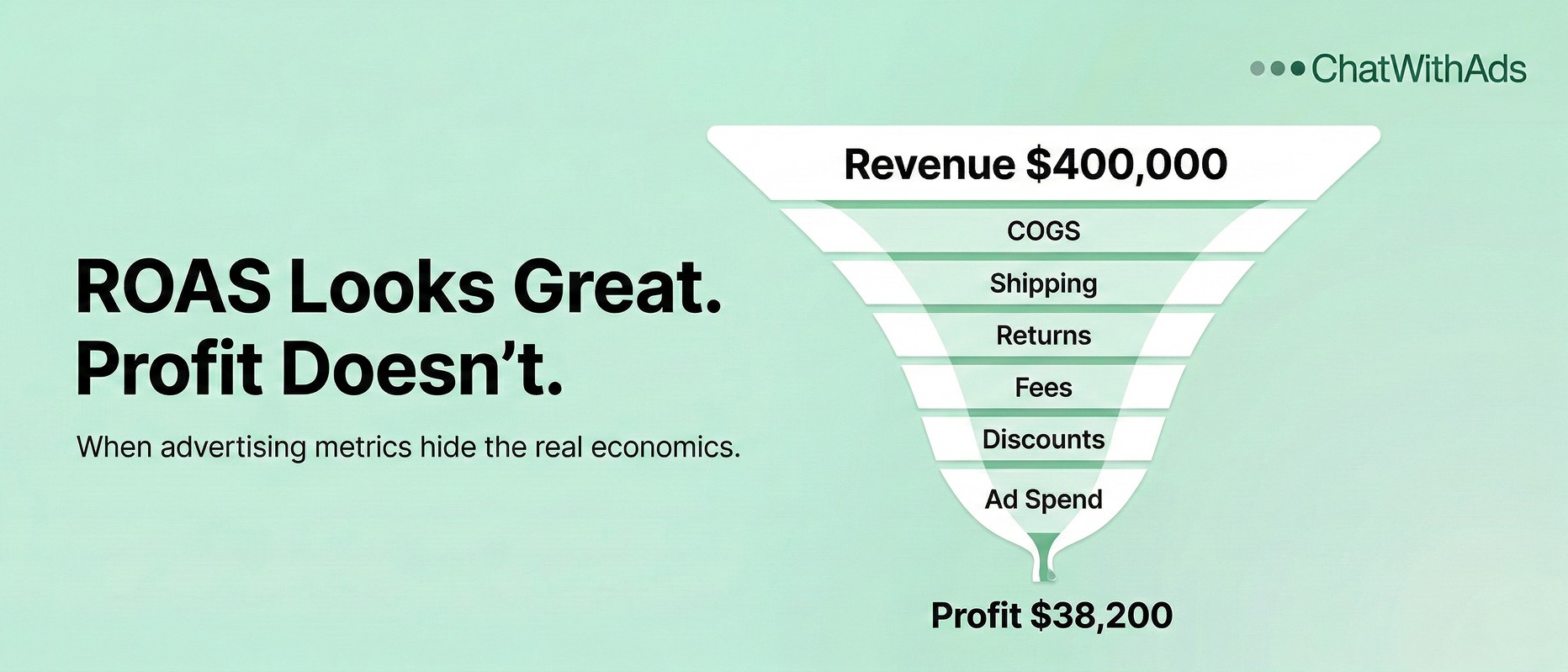
But ROAS doesn't account for:
Cost of goods sold (COGS)
Shipping and fulfillment
Payment processing and platform fees
Returns, refunds, and chargebacks
Discounts and promotions
ROAS tells you how efficiently your ads are driving revenue. It doesn't tell you whether that revenue is profitable. It doesn't show you the margin on what you're selling.
This is where ROAS vs profit becomes critical. You can optimize for strong ROAS while simultaneously destroying profitability.
The Real Economics Behind a Sale
You spend $1,000 on ads and generate $4,000 in revenue. Your ROAS is 4x.
Now factor in the actual costs:
Cost of goods sold: $2,000
Fulfillment and shipping: $600
Payment processing & platform fees: $400
Discounts and returns: $800
Total costs: $3,800
Actual profit: $200
Your 4x ROAS delivered just 5% profit margin. The advertising efficiency looks strong, but the actual profitability tells a different story.
This is metric distrust not because the metric is wrong, but because it's incomplete.
Why This Gap Matters More As You Scale
The difference between ROAS and profit becomes more significant as you grow. Here's where businesses commonly run into trouble:
Scaling Low-Margin Products
High-converting products with strong ROAS might have thin margins after accounting for all costs. As you scale these products, revenue grows but profitability doesn't improve proportionally or may even decline.
A product might convert well because of aggressive pricing or because it appeals to price-sensitive customers who are likely to return items. The ROAS looks excellent because the initial revenue is strong. But after factoring in COGS, fulfillment costs, and a high return rate, the actual profit margin is minimal or negative.
When you scale this product, you're scaling volume without scaling profit. The business gets busier, not more profitable.
Discount-Driven Growth
Promotional pricing improves conversion rate and maintains strong ROAS, but discounts come directly out of margin. The advertising efficiency masks deteriorating unit economics.
If you're consistently offering 20-30% discounts to hit your ROAS targets, you're training customers to wait for promotions and reducing the baseline profitability of every sale. The ROAS metric doesn't distinguish between full-price and discounted sales, it just sees revenue.
Hidden Cost Accumulation
Returns, chargebacks, customer service costs, and other operational expenses aren't visible in ROAS calculations but significantly impact profitability. These costs often increase as a percentage of revenue when scaling.
As you grow, you might see higher return rates from customers acquired through certain channels, increased customer service demands from promotional buyers, or rising fulfillment costs as you expand to new markets. None of this shows up in your ROAS dashboard, but all of it affects your bottom line.
Attribution Complexity
A customer might see your ad, not convert, then later search for your brand and purchase through a different touchpoint. Standard attribution may credit the second ad with the conversion, making some channels appear more efficient than they actually are while undercounting the true customer acquisition cost.
This attribution challenge means your reported ROAS might look strong on brand campaigns that are simply capturing demand created by earlier touchpoints. When you try to scale the "efficient" brand campaigns, you're not scaling the demand creation you're just shifting budget to the final touchpoint in a longer journey.
How ChatWithAds Bridges This Gap
This is precisely the problem ChatWithAds was designed to solve.
Rather than manually pulling data from multiple platforms to calculate profitability, you can simply ask: "What's my actual profit by product?" or "Which campaigns are profitable after all costs?"
ChatWithAds connects your advertising performance data with your product costs, fulfillment expenses, return rates, and all the other variables that determine true profitability.
When you need to understand why profit isn't scaling with ROAS, you can ask: "Why is my profit margin declining when ROAS is stable?" and get a clear breakdown of what's changed—whether it's product mix shifts, increasing return rates, rising fulfillment costs, or discount creep.
The platform helps you view profit, not ROAS because while ROAS tells you if your ads are working, profit tells you if your business is working.
What You Should Be Measuring
ROAS remains a valuable metric for evaluating advertising efficiency. But for business decisions especially scaling decisions you need profit-level visibility.
The metric that matters is contribution margin after all acquisition costs:
Profit = Revenue - (Ad Spend + COGS + Fulfillment + Fees + Discounts + Returns)
This shows you what you're actually keeping from each sale, not just what you're generating in revenue.
Understanding this number changes how you evaluate performance. A campaign with 3x ROAS that drives high-margin products with low return rates might be more valuable than a campaign with 5x ROAS that drives low-margin products with high return rates.
The challenge is that most analytics platforms make ROAS easy to track because it only requires data from your ad platforms. Calculating true profitability requires integrating data from your ad accounts, inventory management, fulfillment systems, payment processors, and your ecommerce platform.
This integration challenge is why many businesses default to optimizing ROAS even when they know profit is what ultimately matters. The data exists, but connecting it requires significant manual effort.
This is where ChatWithAds makes a practical difference. Instead of pulling data from multiple platforms and building spreadsheets to calculate profitability, you can simply ask: "What's my actual profit by product?" or "Which campaigns are profitable after all costs?" and get immediate answers that connect all the necessary data sources automatically.
Making Better Decisions With Complete Data
When you have visibility into true profitability, your decisions change:
Channel Evaluation: Instead of optimizing for the highest ROAS, you optimize for the highest profit per dollar spent which might be a different channel entirely.
Product Strategy: You can identify which products drive strong ROAS but weak margins, and which products might have lower ROAS but stronger overall profitability.
Scaling Decisions: Before increasing budgets, you can model whether profitability will hold at higher volumes or whether you're about to scale into unprofitability.
ChatWithAds surfaces these insights by connecting the data that usually lives in separate systems. Instead of spending hours building analysis spreadsheets, you ask questions in plain language and get answers grounded in your complete business data.
This addresses the root cause of metric distrust not by eliminating metrics like ROAS, but by connecting them with the broader context needed to make sound business decisions.
The Path to Sustainable Growth
Strong ROAS is valuable. But sustainable growth requires understanding the complete economics of your business.
The most successful ecommerce brands aren't just optimizing for advertising efficiency. They're tracking contribution margin, monitoring how profitability changes as they scale, and making decisions based on what they're actually keeping.
Here's what separates them: they're not spending hours manually connecting data. They've found ways to access these insights immediately asking questions and getting answers in seconds, not days.
While most brands optimize for ROAS because it's the only metric they can easily track, leading brands optimize for actual profitability. They see profit margin by product, by channel, by cohort in real-time.
The competitive advantage isn't just better data. It's making better decisions faster because the insights are actually accessible.
Tools like ChatWithAds turn questions that used to require hours of analysis into conversations that take seconds. While others build monthly reports, these brands adjust strategy daily based on true profitability.
Because ROAS tells you if your marketing is efficient. Profit tells you if your business is sustainable. And speed tells you whether you're leading or following.
See Your True Profitability
The gap between what ROAS shows you and what your business is actually making is where many growth decisions go wrong.
ChatWithAds helps you see the complete picture by connecting your advertising data with your actual costs and profitability metrics.
Instead of wondering why strong ROAS isn't translating to profit, you can ask direct questions and get clear answers about what's driving your real economics.
Start free at ChatWithAds.com
Move beyond ROAS to true profitability. See what you're actually keeping after all costs. No credit card required.