Wednesday, May 6, 2026
Your Meta Dashboard Has Numbers. It Doesn't Have Context.
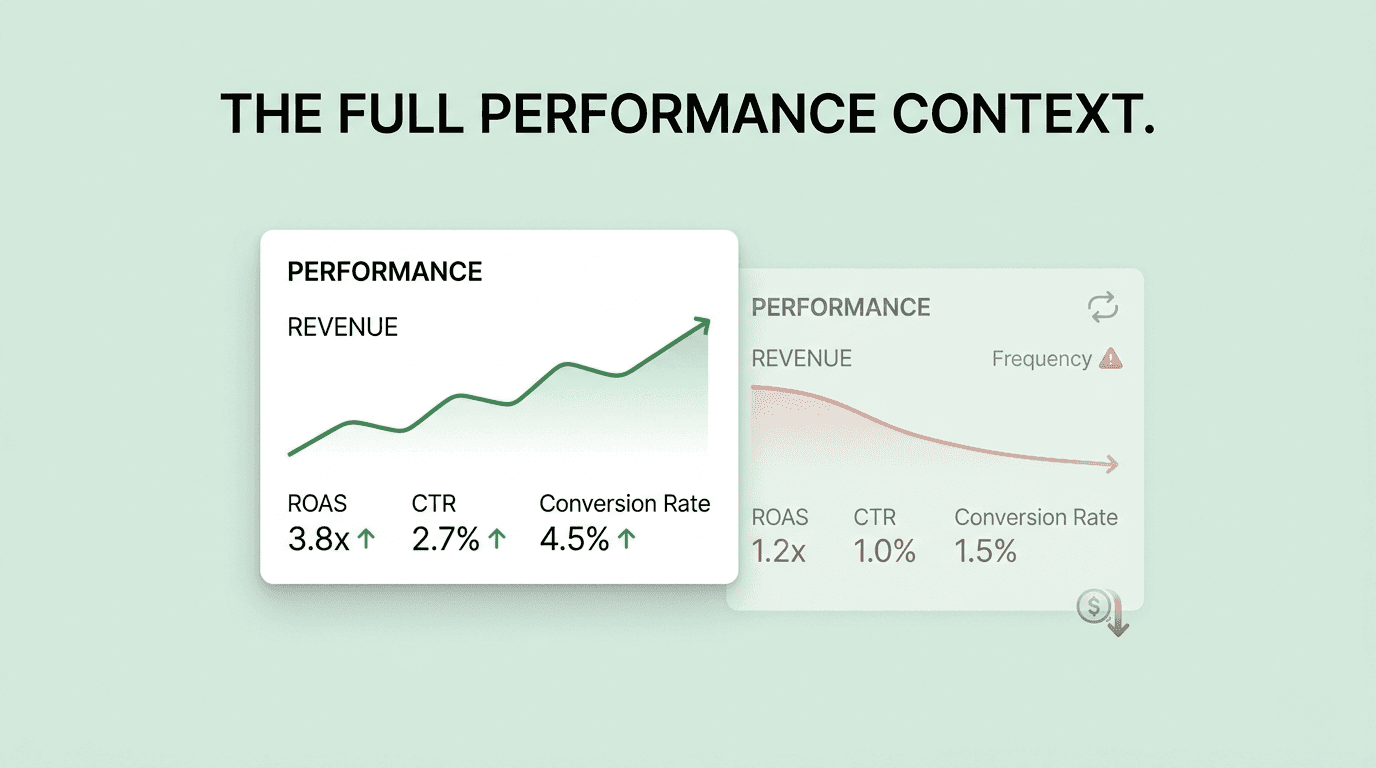
You open Meta Ads Manager. Impressions are up. CTR looks steady. ROAS is sitting at 3.8x. Nothing is broken. Nothing is flagged.
And yet your sales don't match what you're seeing. Your budget is being spent, but the return feels thinner than the numbers suggest. You refresh again. Still nothing obvious.
Here's the problem. Your Meta dashboard isn't broken. It's just not telling you the full story. And the gap between what it shows and what's actually happening in your business? That's where profit disappears.
3 Things Your Meta Dashboard Is Hiding Right Now
Before anything else, this is what's sitting in most ad accounts right now, quietly doing damage.
1. Conversions that aren't really yours. Meta's view-through attribution counts a sale even if someone only saw your ad, never clicked it, and then bought through Google or email three days later. Meta still claims it. Your dashboard still celebrates it. Your actual ad impact is smaller than reported — in most accounts, meaningfully smaller.
2. Frequency killing your efficiency. Frequency measures how many times the same person has seen your ad. Industry benchmarks suggest frequency above 3–4 in a cold audience starts hurting performance. Above 6–7, you're essentially paying to annoy people. But your impression numbers stay healthy, so nothing looks wrong. The dashboard shows you reach. It doesn't show you that the same 200 people have seen your ad nine times this week.
3. One ad set carrying the rest. A campaign ROAS of 4x sounds strong. But inside that campaign, one ad set might be running at 7x while another runs at 1.5x. The average looks acceptable, so nothing gets questioned. You're funding a losing ad set with the profits from a winning one, and the dashboard is letting it happen.
What Meta Is Actually Measuring (And What It's Not)
When Meta reports a conversion, it's doing so within its own attribution window clicks within one day, views within up to seven days by default. That window is designed to capture as much credit as possible for Meta.
This isn't malicious. It's just how platforms work. Every ad platform reports numbers in ways that favor their own performance. Understanding this isn't cynicism, it's just how you use the data accurately.
What this means practically: if you're running Meta ads alongside Google, email, or organic content, your Meta dashboard is almost certainly double-counting conversions that other channels also claim. The actual incremental impact of your Meta spend is lower than what's reported. How much lower depends on your business but an account spending $40k/month can easily find $8–12k worth of claimed conversions that don't hold up when you test attribution properly.
The dashboard tells you what Meta thinks it drove. It doesn't tell you what actually drove your sales.
The Metrics That Look Fine Are the Ones Worth Watching
There's a pattern that shows up in ad accounts before things fall apart. Everything looks stable. Consistent conversions. No red flags. And then, quietly, profitability starts slipping. Not dramatically. Just a little worse each week.
By the time it's obvious, it's been building for months.
Your cost per acquisition creeps up $2–3 each week. Unremarkable on its own. But over three months, that small movement has fundamentally changed whether your campaigns are profitable. A CPA of $28 that drifts to $41 over a quarter doesn't look like a crisis until you do the margin math.
Your returning customer rate drops. Your ad spend shifts toward acquiring one-time buyers without you realizing it. The dashboard keeps reporting conversions. It doesn't tell you that the quality of those conversions has changed.
Stable-looking metrics are the ones that hide the most movement. That's exactly why they're worth questioning.
Your ROAS Number Is Missing Half the Equation
A 3.8x ROAS sounds like a win. Here's what it's not accounting for.
Take a campaign generating $40,000 in revenue. Subtract $12,000 in ad spend. Subtract $16,000 in cost of goods. Add fulfillment, platform fees, and operations another $8,000. You're left with $4,000. Factor in team time and software, and that number shrinks further.
Revenue is the headline. Profit is the reality. Most dashboards only show you the headline.
ROAS doesn't know your margins. It doesn't know your overhead. It doesn't know whether you're acquiring customers who come back or customers who disappear. It's a performance signal, not a profitability answer. Treating it like one is where accounts quietly bleed out.
What Your Dashboard Can't Tell You
The dashboard is a useful tool. But it needs context, interpretation, and the right questions to mean anything.
Context is knowing whether your current CPA is sustainable given your actual margins — not just whether it's lower than last month. Context is understanding your customer lifetime value well enough to know what a good acquisition cost actually looks like for your specific business. Context is knowing which channels are genuinely driving sales versus which ones are showing up in attribution windows after the fact.
None of that comes from staring at your dashboard longer. It comes from knowing what to look for behind the numbers.
Ask Your Dashboard a Question. See What Happens.
This is where ChatWithAds works differently.
Instead of handing you another set of metrics, ChatWithAds lets you have an actual conversation about your account. Connect your ad account, then ask in plain English "what's actually killing my ROAS?" or "which of my ad sets are wasting budget?" or "is my frequency too high?"
You get a straight answer. Not a report to interpret. Not a dashboard to stare at.
We audited an account spending $38,000 a month that looked clean on the surface — solid ROAS, consistent conversions, no flags. Underneath, frequency on their top ad set had climbed to 8.4, one ad set was running at a 1.2x ROAS and dragging the campaign average down, and view-through attribution was inflating reported revenue by roughly 22%. The dashboard showed a healthy account. The reality was significantly different.
If your numbers look fine but your results don't match, that gap is real. Your dashboard just isn't showing you where it's coming from.
ChatWithAds is built to find it. Ask your account what it's actually doing before the gap gets any wider.