Your Ad Platform Counts Conversions. It Doesn't Tell You Which Ones Were Worth It.
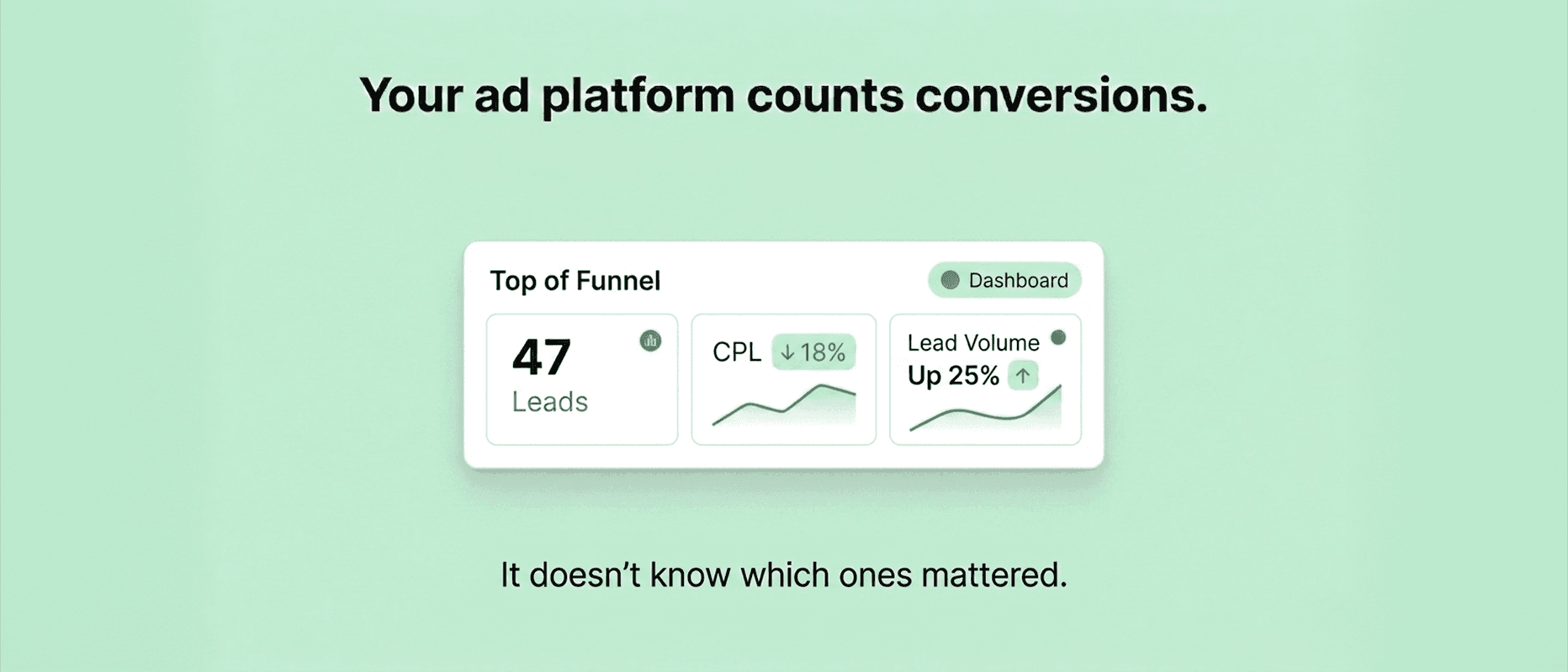
Forty-seven leads last week. Cost per conversion down 18%. Dashboard green across the board.
The sales team was furious. Leads not picking up. The ones that do have no budget. Revenue flat.
This is the most expensive blind spot in digital advertising, and almost nobody talks about it openly. Your ad platform is excellent at counting things. It is genuinely terrible at telling you whether those things were worth counting in the first place.
The Counting Problem Nobody Wants to Admit
Ad platforms were built on a simple premise: someone clicks, something happens, that something gets logged as a conversion. The platform doesn't know if it was a serious buyer or a curious tire-kicker. It doesn't know if the form was filled out by your dream customer or a competitor doing reconnaissance. It just knows the pixel fired.
This worked fine when conversions and revenue had a clean one-to-one relationship with simple e-commerce, where a purchase is a purchase. But for most modern businesses, considering purchases, services, B2B, real estate, education, healthcare, subscriptions a conversion is just the start of a journey. And those journeys vary wildly in value.
Two leads can look identical to Meta. One becomes a $50,000 client. The other ghosts after three follow-up emails. To the ad platform, they are both worth exactly the same: one conversion. So when its algorithm goes hunting for more "conversions" to optimize toward, it has no idea which kind it should actually be looking for.
The result: you spend more money finding more of the wrong people.
Why This Happens
Two structural reasons your ad platform cannot solve this for you.
The platform only sees its own playground. It captures clicks, form fills, and pixel fires. It does not see what happens after the sales call, the demo, the contract, the customer who churns in month two, the renewal in year three. All the moments that actually define value happen in your CRM, your sales calls, your billing system. The platform is making product recommendations based only on what people add to cart, never seeing what they returned.
iOS 14, cookie deprecation, and privacy changes have made platform-side tracking even less reliable than it used to be. Attribution windows are shorter, signals noisier, modeled conversions increasingly synthetic estimates rather than observed events. You are optimizing against a fuzzier picture than you were three years ago, not a clearer one.
The optimization algorithms are doing their job too well. When you tell Meta or Google to optimize for "leads," they will find you lead lots of them, cheaply. The cheapest leads are almost always the lowest-intent ones. The algorithm isn't malicious. It is giving you exactly what you asked for. The problem is that "more leads" was never what you actually wanted. You wanted more revenue, and you used "leads" as a proxy because it was the only signal you could feed back into the system.
The Real Cost of Counting Without Qualifying
Put illustrative numbers to it. A lead-gen account reporting $40 cost per lead. Looks fine. But segment those leads by what they actually became and a typical funnel might look something like this:
60% never respond or are completely unqualified.
30% are early-stage shoppers who won't buy for a year, if ever.
8% are decent fits but eventually go with a competitor.
2% become real customers.
That 2% is the entire business. They are paying for every other lead, plus the ad spend, plus the salaries. True cost per actual customer is not $40 it's closer to $2,000. And here's the brutal part: the ad platform's algorithm has been optimizing for the 60%, because the 60% are easiest to find and look identical to the 2% from where the platform is sitting.
This is how companies scale their ad spend, watch their reported cost per conversion stay flat, and still see their revenue per dollar quietly collapse. The leading indicators look healthy. The lagging indicators tell a different story. By the time finance raises a flag, three quarters of the budget has been spent finding the wrong people faster.
What "Conversion Quality" Actually Means
Conversion quality is the difference between a conversion that moves your business forward and one that just looks like it did on a dashboard. It is the answer to the question your ad platform cannot ask: did this person turn into actual revenue, retention, and growth or did they just trigger a pixel?
To know conversion quality, you need to connect three things that usually live in separate systems:
The ad platform, which knows what campaign, ad set, creative, audience, or keyword brought someone in.
The conversion event, which knows that someone took an action, a form, a call, a signup.
The downstream outcome, which lives in your CRM, your pipeline, your billing platform, and knows what that person was actually worth.
When these three are connected, you can finally answer the question that matters: not "which ads got me leads?" but "which ads got me leads that became revenue?" Those are very different ads. Sometimes the campaign with the highest reported conversion volume is your worst performer once you weigh it by actual value. Sometimes the "expensive" lead source is the only one producing real customers.
Closing the Loop With ChatWithAds
Most marketers already know this. They don't solve it because the manual fix is grinding. Sales forgets to tag opportunities by source. CRM data is a swamp. UTMs get stripped on redirect. The agency report lands two weeks after the campaign you should have killed has burned through another month of budget.
ChatWithAds is built for that gap. Connect your ad platforms, your CRM, and your pipeline once. Then ask in plain language:
"Of last month's leads, which ones closed, and which ads brought them in?"
The answer comes back in seconds. Not a dashboard. Not a SQL query. Not Tuesday's report. The next campaign decision is made against what actually produced revenue not what the pixel happened to fire on.
That's the shift. You stop counting conversions and start understanding them. Over time, your campaigns stop attracting people who fill out forms and start attracting people who become customers, because you finally have a fast, honest way to tell the difference.
Ad intelligence through conversation. No comfortable lies. Just clear answers.
How to Start Thinking About This in Your Own Account
Even before you adopt a specific tool, you can shift the mindset right now.
Stop reporting on raw conversion counts as your top-line metric. Start reporting on qualified conversions, opportunities, or revenue attributed back to campaigns even if attribution is imperfect. Imperfect closed-loop data beats perfect top-of-funnel data every time.
Define what a "good" conversion looks like before you launch the campaign, not after. A lead with a budget over a threshold? A signup from a specific industry? A trial user who completed onboarding? Whatever it is, make sure something or someone is checking each conversion against that bar.
Feed quality signals back to your ad platforms whenever possible offline conversion uploads, enhanced conversions, value-based bidding. Your algorithms can only learn from the feedback you give them.
Audit your funnel quarterly with one question: of the conversions our ad platforms reported last quarter, what percentage actually became revenue? If that number surprises you, you have just found the most valuable optimization opportunity in your entire marketing program.
The Bottom Line
Ad platforms count. They don't judge. They'll cheerfully find you ten thousand more of whatever you told them was good and they won't mention when "good" was actually "garbage." That judgment has to come from you, your downstream data, and a tool that can connect the two without a two-week analyst project.
If your reported cost per conversion looks healthy but your revenue per dollar doesn't, you already know which problem you have. The only question is how much longer you want to pay to find more of the wrong people.
Start Free. No credit card. → chatwithads.com