Why Blended CAC Lies During Scale
You Think You Know Your Numbers
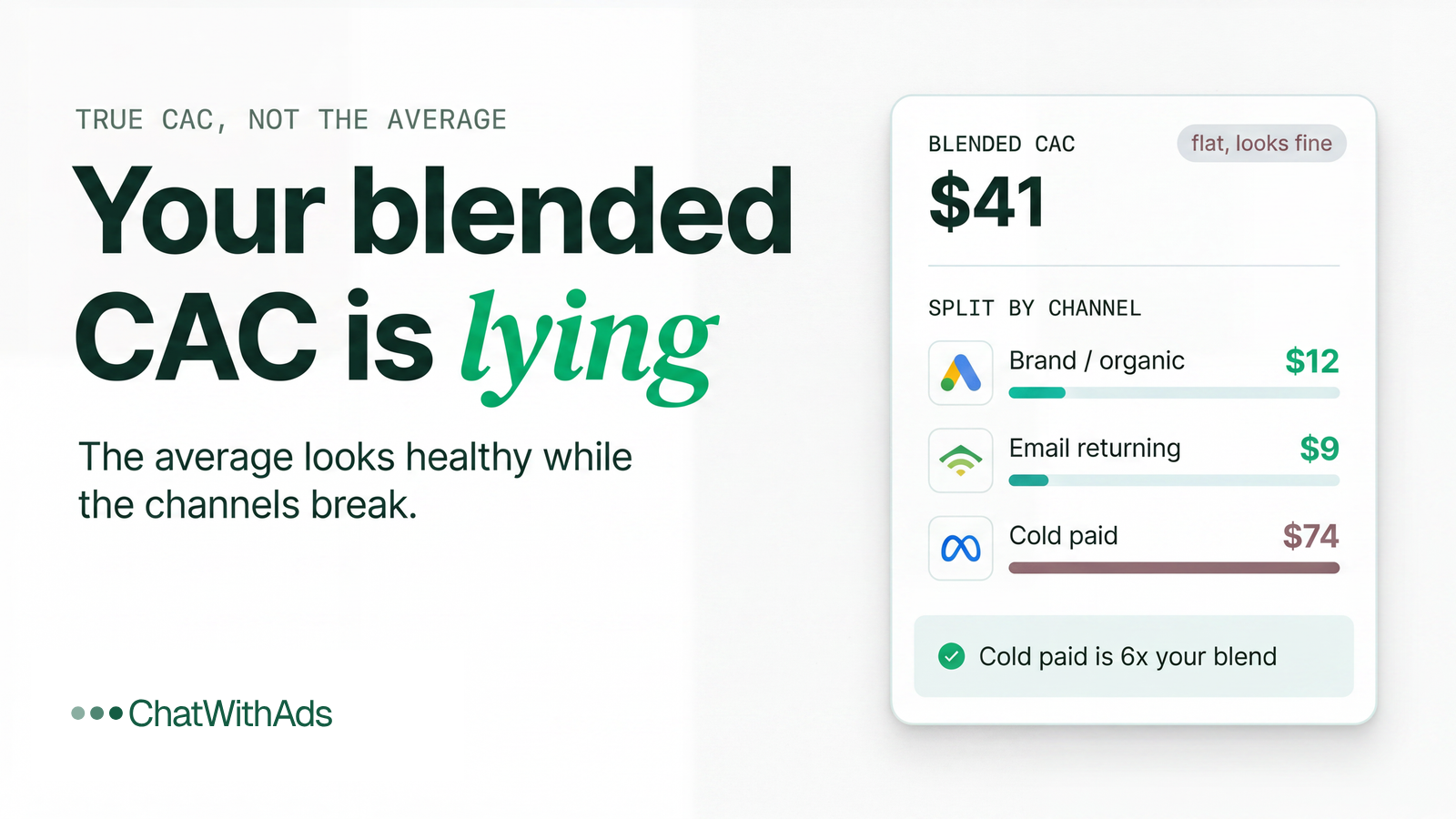
You're ready to push harder.
The blended CAC looks healthy. You've been tracking it for months. It fits comfortably below your customer lifetime value. The model says scale.
So you do. More budget. More channels. More customers are coming in.
But the business doesn't feel like it's working better. It feels heavier. Margins are softer than expected. Cash is tighter than the numbers suggest it should be.
You check the blended CAC again. Still looks fine.
That's the problem.
The Explanations Sound Right But Aren't
Scaling always brings familiar reassurances. "CAC rises naturally as you scale." "Give it time to stabilize." "The data needs a few more weeks."
These aren't wrong exactly, but they're not helping you understand what's actually happening.
The real issue isn't that blended CAC went up. It's that it stayed flat while the business quietly got harder.
Blended CAC is an average. And averages hide more than they reveal. When one number represents every channel, every customer type, every traffic source you're not looking at performance. You're looking at a smoothed-out story that makes things appear more consistent than they are.
Most analytics platforms are built to give you this view. It's clean, simple, and fits neatly into a report. But the questions you actually need answered like which channels are genuinely working versus which are just riding on brand traffic require connecting data that lives in completely different places. That's where the gap opens up.
What the Number Is Actually Hiding
If blended CAC looks fine but the business feels wrong, something underneath shifted.
True Profitability = Channel-Level CAC × Volume × Margin × Retention
Here's what gets buried in the blend.
1. Brand Traffic Is Doing the Heavy Lifting
A portion of your "acquired" customers were already looking for you. They searched your name, came back from an email, or would have converted regardless of your paid campaigns. But they're counted in the same blended CAC as every cold acquisition.
This pulls the average down. When you scale, you're not scaling that brand intent you're scaling the expensive, uncertain part.
Understanding true CAC in ecommerce starts with separating what paid actually earned from what it just happened to be nearby when someone converted.
2. Organic Is Subsidizing Paid
Email brought someone back. A referral worked. Someone found you through search. These are nearly free, dragging the blended number down and making your paid performance look more efficient than it is.
The moment you increase paid spend, you're not scaling the cheap stuff. You're scaling the part that was always expensive it was just hidden in the average.
3. Your Best Audience Is Already Gone
Early campaigns hit your highest-intent segment first. They converted easily, making CAC look exceptional. As you scale into broader audiences, quality drops and cost rises. But because early performance is still in the blend, the overall number barely moves.
You're comparing today's reality against yesterday's highlights. The average flatters you.
4. Channel Mix Changed Quietly
You shifted more spend toward a different platform this quarter. Maybe it felt necessary. Maybe results on the original channel started softening.
But if the new channel carries a higher true customer acquisition cost, the blend won't show it clearly. The average smooths over the migration. You think you're scaling what worked you're actually scaling what's newer and more expensive.
5. Attribution Is Giving Credit to the Wrong Place
A customer saw an ad but didn't click. They searched later, clicked something else, and converted. The last touchpoint gets the credit while the channel that actually created interest gets nothing.
This distorts everything. You optimize toward what attribution rewards and pull budget from what attribution ignores. The blended CAC holds steady while the underlying engine quietly breaks down.
6. New Customers Aren't as Valuable
Your blended number doesn't distinguish between a customer who buys three times a year and one who never comes back.
If scaled cohorts show weaker repeat rates and lower lifetime value, your LTV to CAC ratio is eroding even when the headline acquisition cost looks unchanged.
Customer lifetime value vs CAC is the real question. Blended CAC doesn't ask it.
7. The True Cost Is Higher Than the Formula Suggests
Most blended CAC calculations count media spend and nothing else. They leave out creative costs, agency fees, tools, the support overhead from lower-quality traffic, and returns that reduce net revenue.
Add those back in and the number looks different often significantly different.
What You Can Do About It
Once you understand what's being hidden, you have real options. Each requires making a choice about what matters more.
Option 1: Stop Trusting the Blend
Break CAC down by channel, by campaign type, by new vs returning, by traffic source.
Trade-off: More work. More complexity in reporting.
Benefit: You stop making scaling decisions based on a number that averages away the problems.
This is what true CAC in ecommerce actually looks like.
Option 2: Test What's Actually Incremental
Pause a channel temporarily. See what happens to overall conversions. If nothing changes, that channel wasn't acquiring customers it was taking credit for them.
Trade-off: Short-term discomfort and some uncertainty.
Benefit: You find out which spend is genuinely driving growth and which is just present when growth happens.
The hard part here isn't the concept it's pulling data from different platforms, tracking what moved where, and isolating the actual impact. Most teams know they should do this. Few have the time to actually execute it properly.
Option 3: Reallocate Toward What's Actually Working
Once you have channel-level truth, move budget accordingly. Some channels that looked average in the blend will look strong in isolation. Others will look much worse.
Trade-off: Volume may drop initially.
Benefit: You scale what's real, not what averaged well.
Option 4: Evaluate on LTV, Not Just Acquisition Cost
A channel that brings in loyal, high-value customers at a slightly higher CAC is better than one that looks cheap but brings in one-time buyers.
Trade-off: Requires tracking retention and customer lifetime value by cohort and source.
Benefit: Your scaling decisions are built on actual business health, not just efficiency optics.
Option 5: Calculate the Full Cost
Add creative, tools, agency fees, and support back into the calculation.
Trade-off: The number gets worse. That's uncomfortable.
Benefit: You're working with reality. Decisions made on realistic numbers are better decisions.
What to Look at Next
Find the Breakpoint
Identify when profitability started feeling wrong relative to when blended CAC was "improving." That gap is where the real story lives.
Pull It Apart by Source
Separate brand from non-brand, paid from organic, new from returning. Look at each segment in isolation and see which ones are genuinely performing versus riding on the rest.
The insight here is clear. The execution? That's where it breaks down. You're exporting from Meta, pulling from Google Ads, cross-referencing with Shopify, trying to match timestamps and attribution windows. By the time you've built the analysis, the moment to make a decision has often passed.
Track Cohort Quality Over Time
Are customers acquired in recent months buying again? Are they returning at the same rate as earlier cohorts? If retention is softening as you scale, the acquisition cost problem is only half the picture.
Build the Real Number
Add all acquisition-related costs together, divide by actual new customers, and compare it against realistic lifetime value. That number might be uncomfortable, but it's the one worth knowing.
The Bigger Insight
Blended CAC isn't a bad metric it's just an incomplete one.
The danger isn't that it lies to you directly. It's that it lets you feel confident while the real picture shifts underneath. When you scale, you're not scaling an average. You're scaling specific channels, specific audiences, specific decisions.
If you don't know what's actually working within the blend, you'll scale the wrong things and wonder why growth feels harder than it should.
The brands that scale well aren't the ones with the best-looking blended CAC. They're the ones who understand what's inside it.
The Real Bottleneck
Here's what all of this comes down to: the insights exist. The logic is sound. The questions are clear.
What's missing is the connective tissue. The data that would answer these questions lives in five different places, follows different attribution models, and requires hours of manual reconciliation before you can see anything meaningful.
Most teams know what they should be looking at. They just don't have the bandwidth to actually do it consistently. So decisions get made on the blended number because it's the only number that's readily available even when everyone knows it's incomplete.
That's the gap ChatWithAds was built to close. It doesn't give you more dashboards or more reports. It connects what's already there and surfaces the insights that would otherwise stay buried the channel-level truth, the cohort quality shifts, the attribution distortions without requiring you to become a data analyst first.
When you ask "What's my true CAC by channel?" you're not just getting a number. You're getting the answer to why blended CAC stayed flat while profitability got harder. You're seeing which channels are genuinely driving growth and which are taking credit for traffic that was coming anyway. You're understanding what's working and what's quietly breaking down.
The questions you've been trying to answer? ChatWithAds answers them using the data you already have, connected in ways that standard platforms weren't built to do.
Start free at ChatWithAds.com
The insights that matter most are the ones blended CAC hides. ChatWithAds helps you find them before scaling decisions become expensive mistakes. No credit card required.
Get the next one in your inbox
Marketing-analytics deep dives like this one, straight to your inbox. No spam, unsubscribe anytime.