Saturday, May 2, 2026
What Broke Yesterday? The Post-Mortem of an Ad Account Crash
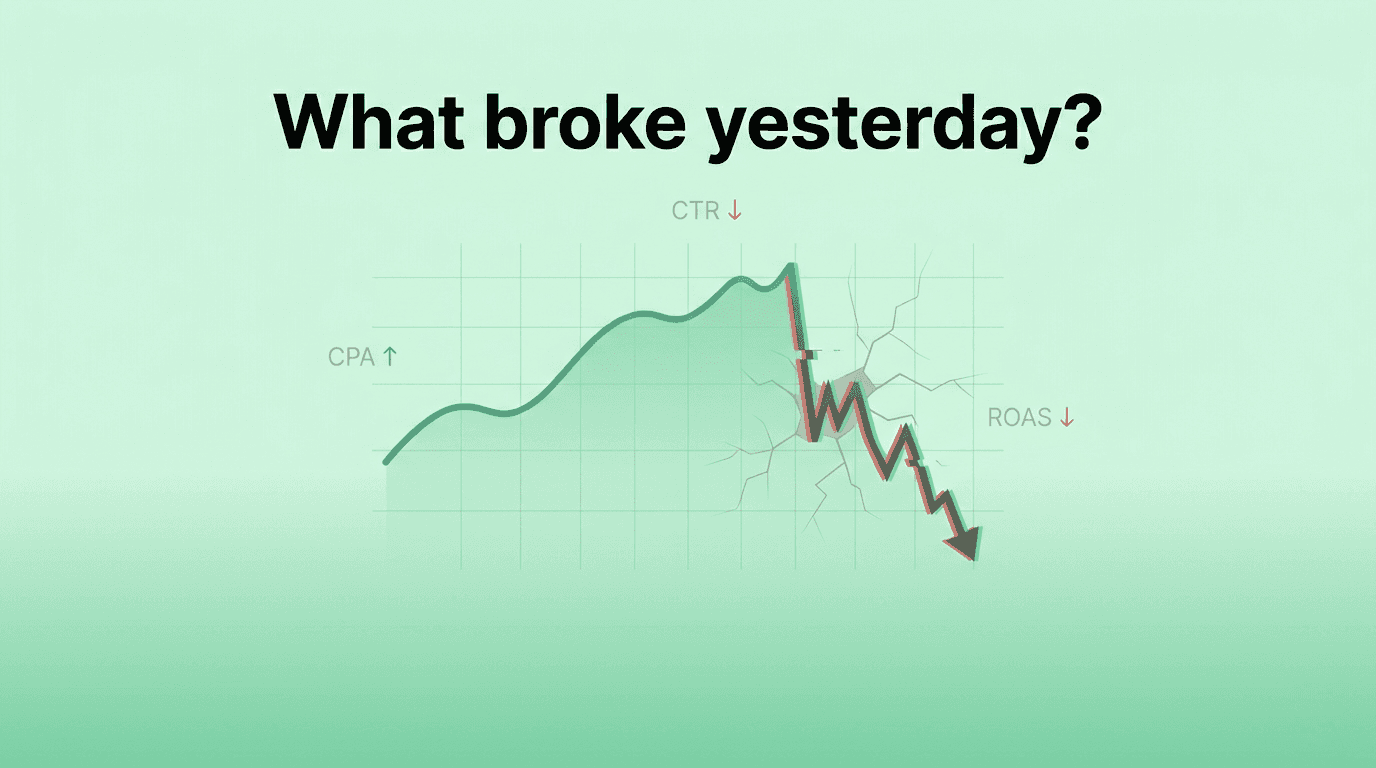
It’s 8:15 AM. You’ve got your coffee, the office is quiet, and you open your main dashboard expecting the usual steady climb of conversions. Instead, you see a cliff. A jagged, ugly drop-off that looks less like a trend and more like a crime scene. Your Cost Per Acquisition (CPA) has doubled, your click through rate is in the gutter, and that healthy ROAS you spent three months building has evaporated overnight.
The panic starts in your stomach and moves to your throat. You start clicking through tabs like a maniac, looking for the "off" switch someone must have accidentally flipped. You check the billing redit card is fine. You check the site it’s loading. You check the Change History nothing. For anyone who has managed seven or eight figure budgets, this isn't just a hypothetical scenario; it’s a recurring nightmare.
This is the moment that separates the amateurs from the veterans. The amateur starts changing everything at once, effectively resetting the learning phase and lighting the remaining budget on fire. The veteran knows that when performance breaks, it’s rarely a mystery; it’s usually a trail of breadcrumbs leading back to a specific, fixable failure. Yesterday, something broke. Let’s figure out what it was and how we’re going to drag it back to life.
Why do we keep pretending that "nothing changed" is an answer?
When we consult o brands[SB1] whose ads have tanked, the first thing we hear is: "We didn't change a single thing. It just stopped working." We hate to be the bearer of bad news, but "nothing changed" is exactly why things broke. Digital advertising isn't a "set it and forget it" machine; it’s a living ecosystem. If you didn't change anything, your competitors did. If you didn't change anything, the algorithm’s appetite did. If you didn't change anything, the creative that was fresh two weeks ago is now wallpaper that your audience is actively ignoring.
The "nothing changed" defense is a myth because it assumes the market is static. It’s not. External factors competitor bid aggression, seasonal shifts, or even a local holiday can render your "static" strategy obsolete in twenty-four hours. Real ad performance analysis requires you to stop looking at your ads in a vacuum and start looking at them as one moving part in a very noisy room. You have to realize that every time you enter an auction, you are being compared against everyone else in real-time. If you stay still while the world moves, you are effectively moving backward.
Is the algorithm actually out to get you?
Most marketers love to blame the "algorithm update" for their failures. It’s a convenient ghost in the machine. While Google and Meta do shift the goalposts frequently, a sudden 50% drop is rarely just a "tweak" by the platform. It’s usually a signal that you’ve hit a threshold or a technical ceiling.
The Budget Ceiling and Pacing Issues
Sometimes, the system just stops spending or starts spending poorly because it’s trying to hit a target it can no longer reach. If you have a Target CPA set too low, and the auction prices in your niche spike, the algorithm will simply stop showing your ads to high quality users because it knows it can't "buy" them for your price. You aren't being punished; you’re being outbid. This often happens on Tuesdays or Wednesdays when corporate budgets refresh or mid-week sales push the auction floor higher.
The Creative Fatigue Threshold
This is the silent killer. Your ads work until they don't. Every piece of creative has a shelf life. When your frequency starts creeping up and your CTR starts sliding down, the platform sees that users are no longer engaging. To protect the user experience, the platform raises your floor prices. Suddenly, you’re paying a premium to show an ad that nobody wants to see. That’s a recipe for a crash. You have to understand that the algorithm is a matching engine; it wants to match great content with interested people. If your content stops being "great" in the eyes of the audience, the machine stops giving you the "preferred" traffic.
Where does the investigation actually begin?
When you’re staring at a red dashboard, you need a triage process. You don't start by rebuilding the campaign; you start by ruling out the obvious. If you lose your keys, you check your pockets before you call a locksmith. The same logic applies here.
First, look at the tracking. If your sales are still coming in through your backend but your dashboard says zero, you don't have a marketing problem; you have a data problem. This is where advertising roi tracking becomes your north star. If your GTM tags are broken, your server-side API stopped communicating, or a site update stripped out your conversion pixels, your ads are "flying blind." The algorithm will start optimizing for the wrong things because it isn't receiving the conversion signals it needs to stay on track. This happens more than most people admit usually because a developer "fixed" a script and accidentally nuked the tracking header.
Second, check the "Change History" with a cynical eye. Did someone "just" tweak a bid? Did a developer "just" update the landing page header? Small changes have massive ripple effects in automated bidding environments. If a change happened 48 hours ago, and the drop happened 24 hours ago, you’ve likely found your culprit. Automated bidding needs stability to learn. If you're constantly poking the bear, don't be surprised when it bites.
Are you watching the numbers that actually pay the bills?
Not all data is created equal. I’ve seen marketers spend three hours debating the "Impression Share" of a campaign that hasn't made a sale in a week. That is a waste of breath. If you want to know what metrics to track for google ads, you have to look at the ones that indicate intent and profitability, not just vanity. You need to distinguish between "leading indicators" (what's about to happen) and "lagging indicators" (what already happened).
The "Core Four" of Troubleshooting
Conversion Rate (CVR): If your CTR is fine but CVR is down, your landing page is broken or your offer is suddenly uncompetitive. Check your checkout flow. Check for high-friction pop-ups that might have been enabled.
CTR (All): If this drops, your creative is dead or your targeting has shifted into a low-quality audience pool. It means people are seeing your ad and deciding it’s not worth their time.
CPC: If this spikes suddenly, a new competitor has likely entered the auction or your quality score has taken a hit. High CPCs are often the "symptom" of poor creative or poor landing page relevance.
ROAS/CPA: These are the results of the other three. They tell you if you are dying; the others tell you how.
When people ask me how to analyze google ads performance during a crisis, I tell them to look for the "Break Point." Find the exact hour the trend shifted and cross-reference it with any external event. Did a competitor launch a 50% off sale? Did your site speed drop by two seconds? The data is a map, but you have to know how to read the terrain. If you don't know your baseline, you can't identify an anomaly.
What metrics are actually worth your time?
Stop looking at the high-level averages. Averages lie. They hide the fact that one ad group is carrying the entire account while three others are bleeding cash. You can have an account-wide ROAS of 3.0 that looks "fine," while your best-performing campaign just dropped from a 6.0 to a 2.0. The average hides the carnage.
To get a real handle on the situation, you need to dive into ad campaign analytics with a focus on segmentation. Look at performance by device. Look at it by location. I once saw a 30% performance drop that was entirely caused by a technical glitch on Android devices that made the "Buy" button unclickable. The desktop users were fine, but the "Average" CPA looked like a disaster. If you don't segment, you're just guessing. You need to look at the day parting is performance only dropping in the evenings? That might suggest a specific competitor is out-bidding you during peak hours.
Understanding ad performance metrics to track means knowing the difference between "noisy" data and "signal" data. Your "Search Lost IS (Rank)" is signal; it tells you that Google thinks your ad or landing page is low quality. Your "Average Position" was noise because being #1 doesn't matter if the click doesn't convert. Look at the metrics that tell you why the machine is rejecting your bids or why the users are bouncing.
How many small mistakes add up to one giant disaster?
What most marketers get wrong is the "one big fix" mentality. They think there is a single button they can press to make the ads work again. In reality, performance crashes are usually the result of "optimization debt." You let the creative get a little too old. You let the negative keyword list get a little too dusty. You ignored the rising CPCs because the ROAS was still "okay." Then, one day, the weight of those small negligence’s becomes too much, and the campaign collapses.
The biggest mistake? Panic editing. When things break, the instinct is to change the bid, change the copy, and change the audience all at once. This is the fastest way to ensure you never figure out what was actually wrong. You’ve created a new environment where the old data is useless. You’ve thrown the campaign back into a "Learning Phase" with no benchmark for success. It’s like trying to fix a car engine by replacing every part simultaneously while the car is moving.
Another common pitfall is misinterpreting attribution. If you’ve implemented google ads roi tracking correctly, you should see how your search ads interact with your social ads. If your Meta ads performance drops, your Google Brand Search will often drop too. If you only look at Google, you’ll think Google is broken, when in reality, your top of funnel fuel has run dry.
What happens when you stop reacting and start fixing?
Recovery isn't about being fast; it's about being surgical. If you’ve identified that the issue is creative fatigue, don't just swap one image. Test three different hooks. If the issue is a competitor outbidding you, don't just raise your bids blindly. Re-evaluate your margins to see if you can actually afford to pay more for those clicks.
Practical recovery looks like this:
Revert to the last "Known Good" state: If a specific change caused the drop, undo it immediately. Don't try to "optimize" your way out of a bad change.
Refresh the "Hero" creative: If your top performing ad is dying, it’s dragging the whole account down. Give it a new look, a new headline, or a completely different angle.
Audit the Auction Insights: See who is eating your lunch. If a new player is bidding 80% of the time on your top keywords, you need a new strategy perhaps focusing on long tail keywords where they aren't present.
Check Site Health: Run a page speed test. Check your mobile responsiveness. If your page load time jumped from 2 seconds to 5 seconds, your conversion rate will drop by half, and your ads will "break" as a result.
The hard truth about being proactive
The best way to handle a performance drop is to make sure it doesn't happen in the first place. This sounds like "fluff," but it’s actually about building a "margin of safety" into your accounts. You should never be reliant on a single creative, a single audience, or a single landing page.
You should always have a "Challenger" campaign running. While your "Control" campaign is doing the heavy lifting, your Challenger should be testing new audiences, new creatives, and new landing pages. If your Control campaign breaks tomorrow, you should already have a tested, proven alternative ready to scale. If you're only starting to think about new creative after the old stuff dies, you've already lost the momentum. Proactivity is the only defense against the inevitable volatility of the auction.
Advertising is a game of probability and endurance. Things will break. The platforms will glitch. Competitors will be irrational. But if you have a grounded, data driven process for investigation, a "crash" isn't a disaster it’s just a signal that it’s time to evolve. Stop staring at the red numbers and start looking for the "Why." The answer is in the data, but it requires you to be a detective, not just a dashboard watcher. Get back in there, run the numbers, and fix the machine.
Before you jump back into your dashboard and start making changes, ask yourself this:
Are you reacting to noise or actually diagnosing the problem?
If you want a clearer view of what’s really happening inside your ad account and how to fix it before it spirals , log in to your CWA dashboard and see the signals most marketers miss. The difference between guessing and scaling often comes down to what you can actually see.