MER vs POAS: Which Metric Actually Scales Brands?
Two Numbers. Two Different Stories About Your Business.
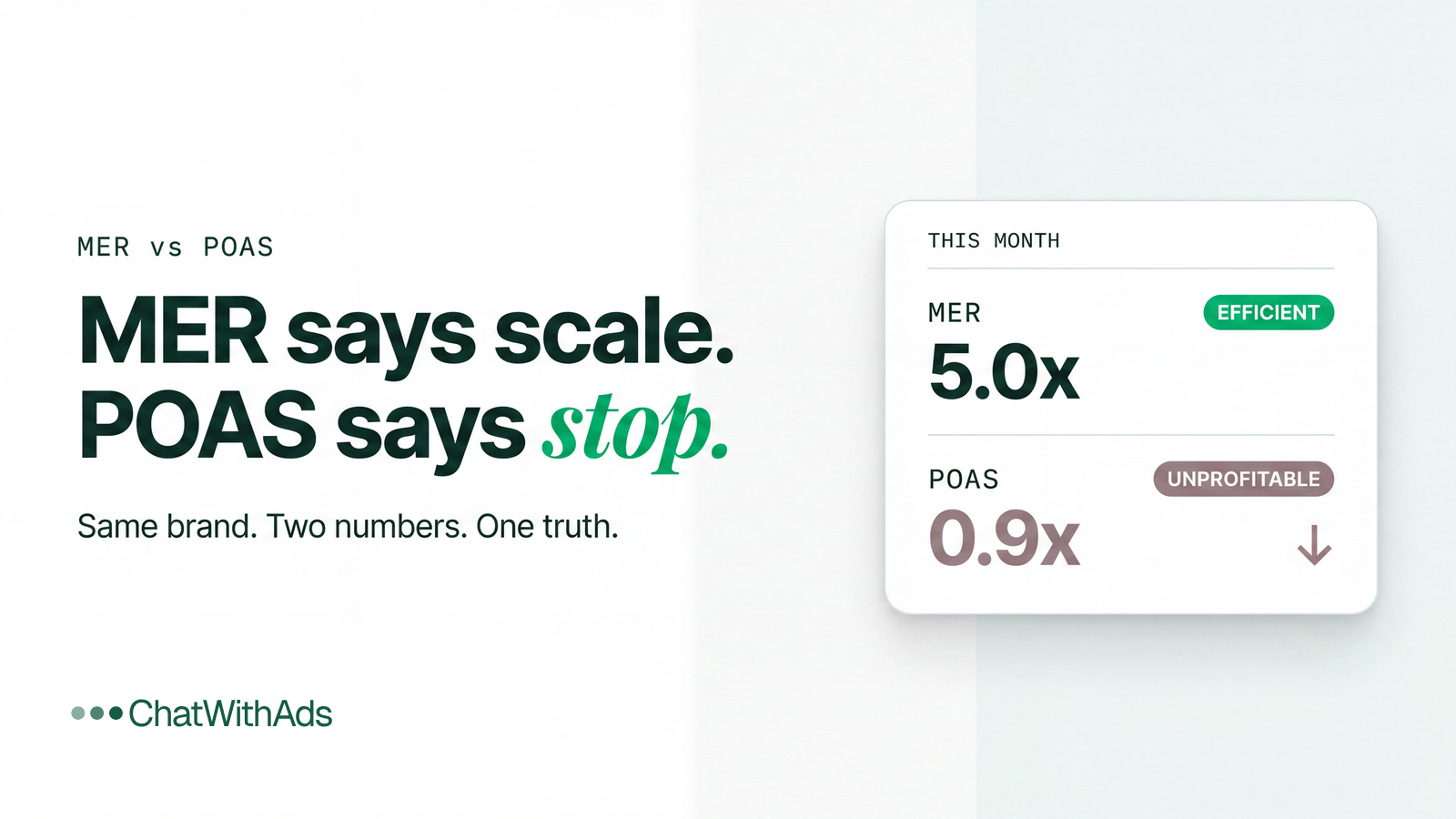
You're tracking MER Marketing Efficiency Ratio. It's showing you how much revenue your total marketing spend generates.
Or maybe you're tracking POAS Profit on Ad Spend. It's showing you how much profit your advertising delivers.
Both sound important. Both claim to tell you whether your marketing is working. But they're measuring fundamentally different things and choosing the wrong one can lead you to make scaling decisions that look smart on paper but damage your business.
The question isn't which metric is "better." It's which one actually tells you what you need to know to scale profitably.
What MER Actually Measures
MER (Marketing Efficiency Ratio) is simple: Total Revenue ÷ Total Marketing Spend.
If you spend $10,000 on all marketing combined and generate $50,000 in revenue, your MER is 5x.
MER is useful because it's comprehensive. It includes every marketing dollar paid ads, influencer partnerships, email tools, agencies, everything. It shows you the overall efficiency of your entire marketing operation.
But here's what MER doesn't show you: profit. A strong MER tells you that marketing is driving revenue efficiently. It doesn't tell you whether that revenue is profitable after accounting for product costs, fulfillment, fees, and everything else required to actually deliver what you sold.
What POAS Actually Measures
POAS (Profit on Ad Spend) is different: Profit ÷ Ad Spend.
If you spend $10,000 on ads and generate $15,000 in profit after all costs, your POAS is 1.5x.
POAS focuses specifically on profitability. It accounts for the actual margin you're keeping after product costs, fulfillment, fees, discounts, and returns. It tells you whether your advertising is generating profit, not just revenue.
But POAS has its own limitation: it only looks at ad spend, not total marketing investment. If you're spending on agencies, creative, tools, and other marketing costs, POAS doesn't capture the complete picture of what it takes to generate that profit.
Why This Distinction Matters
Here's where MER vs POAS becomes critical for scaling decisions.
You can have a strong MER while your POAS is weak or even negative. This happens when marketing is efficiently driving revenue, but the products you're selling have thin margins or high costs that consume most of that revenue.
Conversely, you can have strong POAS while your MER is declining meaning your ad spend is profitable, but your total marketing efficiency is dropping because of rising costs elsewhere in your marketing stack.
Most ecommerce brands default to tracking MER because it's easier to calculate and gives a clean, top-line view of marketing performance. But if you're making scaling decisions based only on MER, you might be growing revenue while eroding profitability.
When MER Hides Problems
MER looks at efficiency across all marketing. But efficiency isn't the same as profitability.
Here's a common scenario: Your MER is 5x. Marketing is driving strong revenue relative to what you're spending. Everything looks healthy.
But when you factor in that you're selling low-margin products with high return rates, your actual profit after all costs is minimal. You're efficiently generating revenue that doesn't translate to business health.
MER told you the marketing machine is working. It didn't tell you whether the business model is working.
This is where many brands scale into trouble increasing marketing spend because MER looks strong, without realizing they're scaling unprofitable revenue.
When POAS Misses Context
POAS, on the other hand, focuses on profit. But it only accounts for ad spend, not your complete marketing investment.
If your POAS is strong but you're spending heavily on agencies, creative production, analytics tools, and other marketing overhead, your true marketing profitability might be lower than POAS suggests.
Additionally, POAS can make it harder to evaluate top-of-funnel investments that don't directly generate immediate profit but are critical for long-term growth things, like brand building, content marketing, or awareness campaigns.
Which Metric Actually Matters?
The honest answer: it depends on what question you're trying to answer.
Use MER when: You need to understand overall marketing efficiency and whether your total marketing investment is generating proportional revenue. It's useful for high-level evaluation and comparing efficiency across time periods.
Use POAS when: You're making decisions about ad spend specifically and need to know whether that spend is generating profit, not just revenue. It's critical for understanding unit economics and ensuring your advertising is sustainable.
But here's the real challenge: neither metric alone gives you the complete picture. You need both plus the context of what's driving the numbers underneath.
A strong MER with weak POAS tells you marketing is efficient but profitability is a problem. Weak MER with strong POAS tells you ad spend is working but broader marketing efficiency needs attention.
The brands that scale successfully aren't choosing one metric over the other. They're understanding both, and they're connecting these metrics to the underlying business realities product margins, customer acquisition cost, retention, and true profitability.
How ChatWithAds Helps You See Both
This is where ChatWithAds makes a practical difference.
Instead of tracking MER in one place and trying to manually calculate POAS by pulling data from multiple systems, you can simply ask: "What's my MER and POAS this month?" and see both metrics with the context you need to understand what they mean.
When you're evaluating whether to scale, you can ask: "Is my POAS strong enough to support higher ad spend?" or "Why is my MER declining when revenue is growing?" and get answers that connect the metrics to your actual business performance.
ChatWithAds doesn't just show you the numbers. It helps you understand what those numbers mean for your specific situation which products are driving profit, which channels are efficient, and whether your metrics suggest healthy scaling or hidden problems.
This is how you move from asking "Which metric should I track?" to "What do these metrics tell me I should do?"
Making Better Scaling Decisions
The brands winning in ecommerce aren't debating MER vs POAS. They're tracking both, understanding what each metric reveals, and making decisions based on complete visibility into their economics.
They know that strong MER with weak margins means they need to fix profitability before scaling. They know that strong POAS with rising overhead means they need to optimize their broader marketing efficiency.
And they're not spending hours manually connecting data to calculate these metrics they're using tools that surface these insights immediately so they can act on them while the opportunity is still there.
ChatWithAds was built to close this gap. Not by telling you which metric to track, but by helping you understand what both metrics reveal about your business and what that means for your next decision.
Ask ChatWithAds Which Metric Matters for You
The right metric isn't universal. It depends on your business model, your growth stage, and what you're trying to optimize.
ChatWithAds helps you understand which metrics matter most for your specific situation. Instead of choosing between MER and POAS, you can ask: "Which metric should I focus on right now?" and get an answer based on your actual business data.
When other brands are still debating which number to track, you're already making decisions based on what those numbers mean.
Start free at ChatWithAds.com
Stop guessing which metrics matter. Get clarity on what's actually driving your business and what you should optimize next. No credit card required.
Get the next one in your inbox
Marketing-analytics deep dives like this one, straight to your inbox. No spam, unsubscribe anytime.