Wednesday, April 1, 2026
How to Reallocate Ad Spend Across Channels (Without Guessing)
When More Budget Doesn't Mean More Results
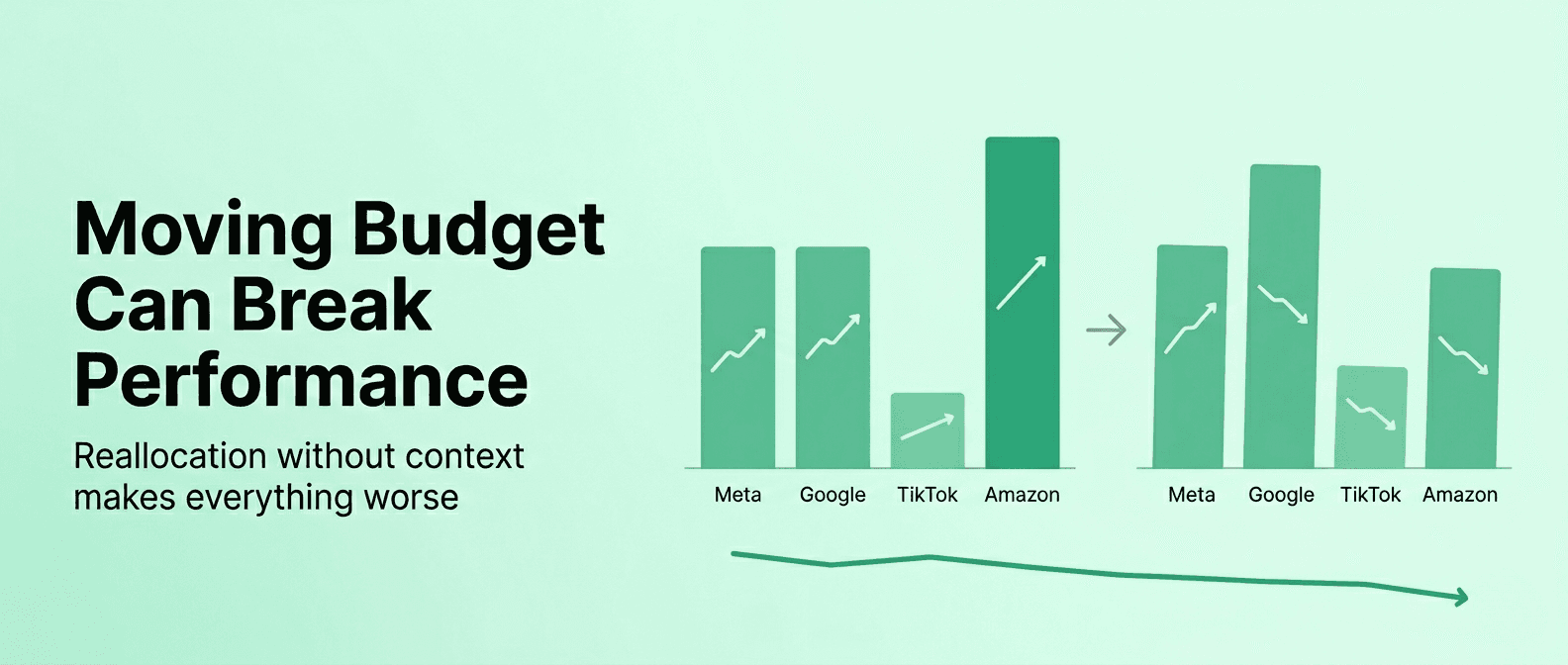
A brand moves a chunk of its Meta budget over to Google on a Tuesday. By Thursday, Meta's algorithm has destabilized campaigns that fall out of the learning phase, acquisition costs spike. It's a familiar cross-channel ad spend problem. Google doesn't suddenly become a goldmine either. It just has more money chasing the same keywords, and clicks get more expensive.
By month's end, the same total budget produces fewer conversions. Nothing was cut. Nothing was paused. Money just moved from one place to another, and somehow everything got worse.
This is a common story. Not because the team made a bad call, but because the information needed to make a good one didn't exist in any single dashboard.
Every Platform Is Grading Its Own Homework
Here's what a typical customer journey looks like. Someone sees a TikTok ad on Monday. Doesn't click. Wednesday, a Meta retargeting ad appears. They click through, browse the site, and leave. Friday, they Google the brand name, click a search ad, and buy a $100 product. One sale. One hundred dollars.
But TikTok claims that conversion through view-through attribution. Meta claims that the click happened this week. Google claims it was the last click. Three platforms each report $100 in revenue for a single purchase. The combined dashboards say $300. The bank account says $100.
This isn't a bug. Every platform measures performance using its own rules, its own attribution windows, its own definition of what counts. None of them are lying, exactly. They're each telling a version of the truth that makes them look good. It's like asking three salespeople who closed the deal. They'll all take credit.
Across the DTC landscape, it's common for platform-reported revenue to add up to nearly double the actual total. That's not a rounding error. That's a structural problem. And it's why budget reallocation ads decisions feel like guesswork when there's no honest picture of what each channel is doing, there's no confident way to decide where to spend more or less.
The Questions That Actually Matter
Most attempts to reallocate ad budgets start with ROAS. One channel shows a higher return, so the money moves there. Simple enough. Except it's not.
A channel with strong ROAS selling a low-margin product can be barely breaking even or losing money once cost of goods and shipping are factored in. Meanwhile, a channel with a lower ROAS selling a higher-margin product might be far more profitable per sale. ROAS without margin data is decoration. It shows how much revenue came back per dollar spent, but says nothing about whether the business actually made money.
Then there's the incrementality question: would the customer have bought anyway?
Branded search is the classic example. Someone types a brand name into Google, clicks a paid search ad, and converts. Google counts it as a win. But that person already knew the brand. They were already on their way to buy. The ad just paid for a click that would have happened organically.
Airbnb discovered this at a massive scale. The company cut a significant portion of its performance marketing spend, and revenue kept growing. Most of that budget had been capturing demand that already existed, not creating it.
Testing this doesn't require a massive budget. Pausing a channel for a short period and watching what happens to total sales, not just that channel's reported numbers reveals a lot. If overall revenue barely moves, the channel was taking credit for demand it didn't create. If revenue drops, it is doing real work.
And then there's the question most teams miss entirely: how are channels working together?
A brand notices TikTok has a weak ROAS and cuts the budget. A couple of weeks later, Meta retargeting performance drops. Google branded search volume decreases. What happened? TikTok was introducing the brand to new people who converted later through other channels. Cutting TikTok meant cutting the top of the funnel, and everything downstream felt it.
Jones Road Beauty uncovered something similar through post-purchase surveys. Meta had been taking credit for sales that actually started with TikTok content and organic word-of-mouth. The platform data told one story. Reality told another.
Channels don't work in isolation, even though every dashboard treats them like they do.
When All the Data Connects
The data to answer all of these questions already exists; it's just scattered across Meta, Google, TikTok, Shopify, Klaviyo, and more, measured in different ways. ChatWithAds was built to connect it into one place and make it conversational. Instead of pulling reports and building spreadsheets, the answer to a budget question is one question away.
How to Reallocate Without Breaking Everything
The most common mistake is making large, sudden shifts. Moving a big portion of one channel's budget to another in a single day doesn't just test a new strategy, it sabotages the old one. Algorithms need stability. Big budget changes trigger learning phases that tank performance for weeks.
The smarter approach is gradual. Small shifts over time, with a few weeks between each one to measure what actually changed. Before moving anything, it helps to model the outcome first especially for scenarios like the TikTok example above, where cutting one channel quietly damages the others. In ChatWithAds, a question like "What happens if I shift some of my Meta budget to TikTok?" pulls from real cross-channel ad spend data to show the likely impact, before any money moves.
Once a shift is made, the thing to watch isn't individual channel dashboards; those are the same ones reporting $300 for a $100 sale. It's MER Marketing Efficiency Ratio. Total revenue divided by total ad spend. No attribution model. No platform bias. Just a clean read on whether the overall marketing program got healthier or weaker. Tracking this in ChatWithAds "How has my MER trended since the budget shift?" makes it easy to see whether a reallocation is working, without reconciling numbers across five tabs.
It's also worth questioning the best-performing channel. The highest-ROAS channel might also be the most over-funded one; every channel eventually hits diminishing returns. And as the ROAS-vs-margin problem showed earlier, strong ROAS on a low-margin product can mean almost no profit. Asking "Which channels are driving the most profitable customers?" ChatWithAds surfaces that gap directly, connecting ad performance to actual margin data rather than just revenue.
The same goes for incrementality. Rather than pausing a channel and hoping the data tells a clear story, asking "Is Google actually driving new customers, or capturing demand that already exists?" ChatWithAds surfaces the kind of insight that platform dashboards bury. A channel that looks like a top performer might just be good at taking credit.
The brands making the smartest budget reallocation ads decisions aren't the ones with the biggest analytics teams. They're the ones that stopped trying to piece together the truth from conflicting dashboards and started asking their data directly.
That's the difference between moving a budget with confidence and moving it with crossed fingers.
Start free at ChatWithAds.com
Stop guessing where to allocate budget. Ask your data directly and reallocate with confidence. No credit card required.