Wednesday, April 29, 2026
How to Catch Anomalies Before CAC Spikes
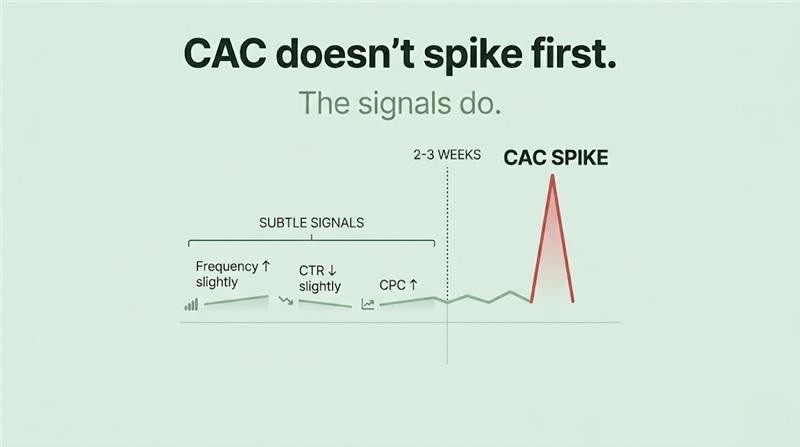
By the time CAC spikes, the problem has been sitting in your account for two weeks. The number doesn't move first the signals do. If you're only watching CAC, you're always too late.
CAC is a lagging metric. Stop treating it like a dashboard.
CAC tells you what already happened. It moves after frequency climbs, after CTR drops, after your best audience saturates. Every CAC spike is a story that started somewhere else in the account, often two to four weeks earlier.
The brands that scale efficiently aren't watching CAC. They're watching the things that move CAC and acting on them before the number lands.
The five signals that move before CAC does
1. Frequency rising while CPM holds flat.
You're paying the same to show ads to people who've already seen them. A frequency drift from 2.1 → 4.3 over 14 days, with CPM steady, is almost always followed by a CAC jump the next week. Same spend, fewer fresh eyeballs.
2. CTR sliding week over week.
Not a sudden drop a slow decline of 8–12% week over week is the early creative-fatigue signal. Refresh before CTR cuts in half, not after.
3. CPC up, conversion rate flat.
Rising CPC alone is noise. Rising CPC with no improvement in landing-page conversion means you're paying more per visit and getting nothing back for it.
4. ROAS flattening as spend scales.
When you increase budget and ROAS plateaus instead of stepping down gracefully, you've hit audience saturation in that ad set. Pushing more budget at it from here just inflates CAC.
5. Landing-page bounce rate climbing.
Your audience or your ad promise has shifted. Either way, the page is no longer doing what it used to. CAC follows within a week.
Why do dashboards not catch this
Checking dashboards daily is not the same as catching anomalies. Dashboards show you a snapshot they don't compare this week's frequency curve to last month's, account for budget changes, or flag drift in context. And when the numbers look "roughly okay" at a glance, the gradual stuff doesn't feel urgent enough to investigate.
Gradual drift is exactly the thing that becomes a CAC spike.
What this looks like in ChatWithAds
Instead of scanning ten metrics across three platforms, you ask:
"What's drifting in my Meta account this week that could spike CAC?"
ChatWithAds connects to your ad accounts, looks at the leading indicators, compares them to your account's own baseline, and returns something like:
Frequency on your top-spend ad set "Cold Lookalike 1%" climbed from 2.4 to 4.1 over the last 11 days while CPM held flat at $14.20. CTR on the same ad set dropped 18% week-over-week. This pattern preceded your last CAC spike on March 12.
Refresh creative or rotate audiences this week.
No dashboard. No 30-minute audit. Plain-language answer, with the actual numbers, anchored to your account's history.
That's the difference between checking an account and catching what's drifting in it.
The bottom line
CAC spikes are predictable. The signals are sitting in your account right now frequency, CTR, CPC, ROAS slope, bounce rate. The only question is whether you see them in week one or week three.
Start Your 7-Day Free Trial
No credit card.